Navigation: Sign
into the Back Office. On
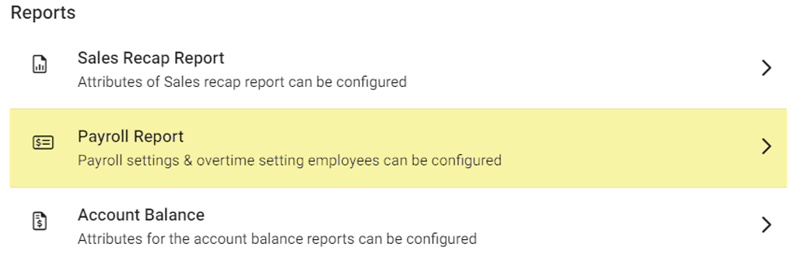
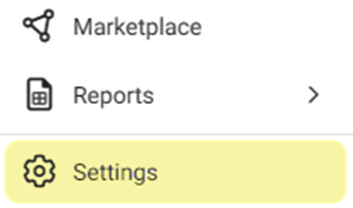
the left side, select Settings. On the Settings page, under Reportsclick Payroll Report.
On the Payroll Report page, 3 tabs appear: Settings, Overtime
Settings, and Manage Breaks.
Settings
Over Time Settings
Manage Breaks
Settings
Allow
Over Tip Out – If enabled (set to YES), the Tip Out will be shared at Tip Adjustment for the Employee.
Payroll
Week Start Day – Select the starting day of payroll from the dropdown. All
7 days are available, and you’re only able to select 1 day.
Default
Payroll Process – Select the cadence of the default payroll processing (Daily, Weekly, or Daily/Weekly).
Minimum
Age – For the Age (years) and the number limit of Hours (both mandatory): enter the values, or use ▲/▼ to increase/decrease the values
by 1.
Select the Terminal to log Break-In/Out from the dropdown, including when offline.
Select whether to include the Weekly clock-in/out details in the clock-out print.
When ready, click Save at the upper-right. The ‘Payroll Settings Updated…’ banner appears and the Save button is greyed-out, confirming that the updates were saved.
Over Time Settings
The + OVERTIME button appears along
with a table that has columns for an Overtime’s Type, Effective Date, Hours, Percentage and Actions(which contains an Edit [pencil]
button).
Click + Overtime. The New Over Time pane appears.
Set the selection for the Overtime (Daily or Weekly).
Daily
Weekly
Consecutive
Workday – Grayed out, with a number value appearing.
Effective
Date – Select a Date (mandatory, calendar view).
Over
Time 1 – Enter the Hours and Percentage.
Enter the number values, or use ▲ / ▼ to
increase/decrease the value by 1.
Percentage –
(mandatory) since the employee is working beyond their normal required hours, the
Overtime pay should be more than the usual rate (greater than 100).
Overtime
2 Hours – Enter the Hours and Percentage.
Enter the number values, or use ▲ / ▼ to
increase/decrease the value by 1.
Hours – (mandatory)
the value must be greater than the Over Time 1 Hours.
Percentage –
(mandatory) since the employee is working beyond their normal required hours, the
Overtime pay should be more than the usual rate (greater than 100).
Overtime
3 Hours – Enter the Hours and Percentage.
Enter the number
values, or use ▲ / ▼ to increase/decrease the value by 1.
Hours – (mandatory) the value must be greater than the Over
Time 2 Hours.
Percentage – (mandatory) since the employee is working beyond
their normal required hours, the Overtime pay should be more than the usual
rate (greater than 100).
When
the new Over Time is set, click Save at the bottom right. You are
returned to the main Payroll Report screen with the Over Time Settings tab, the 'OT Saved Successfully'banner appears at the top right.
Click Cancel to cancel any Over Time updates and close the pane, then
return to the Payroll Report screen.
Hours – (mandatory) Enter the number value, or use ▲ / ▼ to change the value by 1.
Percentage – (mandatory) Enter the number value, or use ▲ / ▼ to change the value by 1.
Since the
employee is working beyond their normal required hours, the Overtime pay should
be more than the usual rate (greater than 100).
Effective
Date – Select the date (calendar view).
When
the new Over Time is set, click Save at the bottom right. You are
returned to the main Payroll Report screen with the Over TimeSettings tab, the banner OT Saved Successfully appears at the top right.
Click Cancel to cancel any Over Time updates and close the pane, then return to the Payroll Report screen.
Edit
Under Actions, if Edit is
clicked:
You can edit details of the existing Overtime.
An Overtime cannot be edited if its Effective Date has not passed.
Note: Based on Payroll Report settings, the report will
function accordingly.
Manage Breaks
On
the Manage Breaks tab, the + NEW BREAK button appears along with
a table that has columns for a Break’s Effective Date, Name, Payroll
Type, Duration, and Actions(which contains a Delete [trash
can] button).
Click + New Break. On the New Break pane that appears:
Select
the Break Name from the dropdown.
Enter
the Duration (Minutes)– Type the value or use ▲/▼ to increase/decrease
the value by 1 (maximum of 100). Only numbers are allowed.
Select the Effective Date (calendar view).
Payroll
Type – Select Paid or Unpaid.
Select
what to Apply To:
All Employees – All employees will be selected.
Specific Roles – Select one or more Roles (or Select all) .
Click a selected box again to deselect it.
Specific
Employees – Select one or more Employees or (or Select all). Click a selected box again to deselect it.
When
the new Break details are set, click Save. You are returned to
the main Payroll Report screen under the Manage Breaks tab, where the new Break has been added as row in the table and the
banner ‘Break Settings Saved Successfully’ appears.
Click Cancel to cancel creating the new Break and return to same page and tab.
Delete a Break Type
Under the Actions column, click the correspondingDelete (trash can).
The Deletepop-up appears.
Select Delete to confirm deleting the Break type.
You're returned to the Manage Breaks tab where the break is removed from the table and the ‘Break Settings Deleted Successfully’ confirmation appears.
Navigation: Sign into the Back Office. On the left-side Navigation Panel, click Settings. On the Settings page, under Reports click Payroll Report. On the Payroll Report settings page, 3 tabs appear: Settings, Overtime Settings, and Manage Breaks. ...
Sign into the Back Office and select a Store. On the left-side Navigation Panel, click Reports then Employee. The Employee report page displays a comprehensive set of data on your staff, with tabs for: Attendance Role Based Payroll Labor Labor By Job ...
Sign into the Back Office. On the left-side Navigation Panel, click Enterprise. Then click Enterprise Reports. Under Enterprise Reports are options to access specific reporting Dashboards: Enterprise Reports Sale Report The Sale Report dashboard ...
Navigation: Sign into the Back Office and select a Retail Store, then select Reports > Employee The Employee Reports page displays a comprehensive set of data on the activity of the Store's employees, with tabs for the following: Attendance Role ...
Navigation: Sign into the Back Office. On the left-side Navigation Panel, click Enterprise. Select Enterprise Reports, and the dropdown contains options to access specific reporting Dashboards: Enterprise Reports Sale Report The Sale Report dashboard ...